“The calendar was a graveyard of good intentions.”
If you’ve ever managed a DMO, chamber, or arts council event calendar, you know the feeling. The events page that hasn’t been updated in three months. Not because you don’t care, but because you’re drowning. Eventbrite here, Facebook there, a dozen venue websites, email submissions, phone calls, and spreadsheets that never quite match up. The manual work is unsustainable, and the result is a stale calendar that visitors learned to ignore.
Sound familiar?
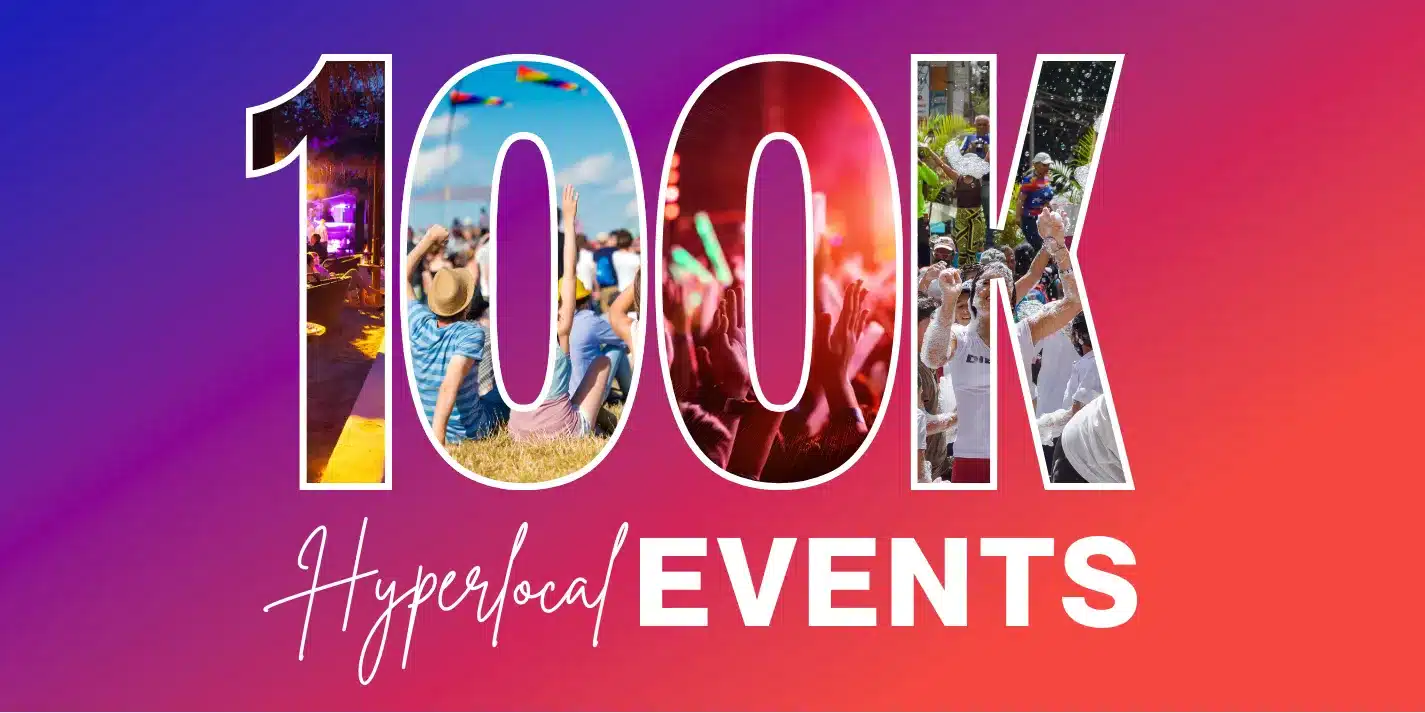
This week, Seeker Events Network crossed a major milestone: 100,000 hyperlocal events discovered, structured, deduplicated, and maintained by AI across our growing network of community publishers. Tennessee Tourism contributed at statewide scale. SF Peninsula routed 500+ sources across 16 cities into a single calendar. Calgary’s four-org co-op pooled events from across one city. The number isn’t the story. What those publishers shipped together is the story.
What is Hyperlocal Event Discovery?
Hyperlocal event discovery is the practice of surfacing every public event happening inside a single market (a city, a county, a region) from every source it appears on, then deduplicating and structuring it into one accurate feed. It’s the layer that makes a community calendar genuinely complete, instead of dependent on whichever venues remembered to submit.
The Problem: Event Calendars Weren’t Built to Scale
Most community event calendars suffer from the same fatal flaw: they’re dependent on manual input.
Venues forget to submit events. Event organizers use different platforms. Information is scattered across dozens of niche sites. Visitors see incomplete, outdated calendars. They stop checking. The calendar becomes a liability instead of an asset.
For DMOs, chambers, arts councils, and event organizers, this creates a no-win situation. Either spend hours every week manually curating events (time you don’t have), or let your calendar go stale (reputation you can’t afford to lose).
The Insight: Curation at Scale Requires a Network
Event calendars don’t scale when each organization works alone. Seeker Events Network uses AI to discover hyperlocal events across a shared network of trusted sources. Communities curate locally; discovery and learning happen across the network. Every new event improves coverage. Every approval improves accuracy.
The Solution: How Smart Communities Are Scaling Event Discovery
Three patterns have emerged from publishers in the network:
The Collaborative Ecosystem. Calgary is the clearest example. Four organizations (Tourism Calgary, Calgary Arts Development, Downtown Calgary, and Red Point Media) contribute into a shared layer of events data for one city. Each org keeps its own editorial control while Calgary, as a place, gets one accurate picture. The more orgs participate, the more comprehensive and valuable the calendar becomes for everyone.
The Automated Hub. SF Peninsula is running this pattern at scale: 500+ trusted sources across 16 cities, with AI doing the discovery and initial filtering and humans approving in a single dashboard. Tennessee Tourism runs it at statewide scale. The result either way: comprehensive, always-current calendars with minimal manual effort.
The Curated Network. One West takes the selective approach. As a niche tourism alliance, they build networks of highly trusted sources and use Seeker Events Network to keep those sources in sync. The result is a “best of” feed that prioritizes quality over quantity. That’s the right pattern for destinations and associations that want to position themselves as curators of exceptional experiences.
What 100,000 Hyperlocal Events Actually Means
100,000 hyperlocal events isn’t just a big number. It represents:
- Millions of visitor experiences that were easier to discover and attend.
- Thousands of hours saved by event organizers and DMOs who no longer manually curate calendars.
- Hundreds of communities, from Visit Tri-Cities and Visit Bellevue to Go Breck, Visit Folsom, Travel Santa Ana, Destination Lancaster, Experience Redmond, and Visit Big Sky, that turned event discovery from a burden into a competitive advantage.
- A network effect in action: the more events we discover, the better our AI gets at finding and categorizing new ones.
Most importantly, 100,000 events represents infrastructure built for scale. Community event discovery doesn’t have to be a manual, unsustainable burden. With the right network, it can be automated, accurate, and useful to both organizers and visitors.
The Road to 1 Million Hyperlocal Events
While others are still debating whether AI has a place in community building, we’ve already demonstrated it. Seeker Events Network isn’t just participating in the future of hyperlocal event discovery. We’re actively building it, alongside Tennessee Tourism, SF Peninsula, Calgary’s co-op, and dozens of destinations and associations from Bellevue to Big Sky.
The communities that thrive in the next decade won’t be the ones with the biggest marketing budgets. They’ll be the ones that make it effortless for locals and visitors to discover what their community has to offer.
100,000 events is just the beginning. Will your DMO, chamber, association, or arts council join us on the road to 1 million?
Running a destination, chamber, or arts council calendar that’s already gone stale this month? Book a demo and we’ll show you what your calendar looks like the first week it’s live on Seeker Events Network.