“The calendar was a graveyard of good intentions.”
If you’ve ever managed a community event calendar, you know the feeling. The events page that hasn’t been updated in three months—not because you don’t care, but because you’re drowning. Eventbrite here, Facebook there, a dozen venue websites, email submissions, phone calls, and spreadsheets that never quite match up. The manual work is unsustainable, and the result is a stale calendar that visitors learned to ignore.
Sound familiar?
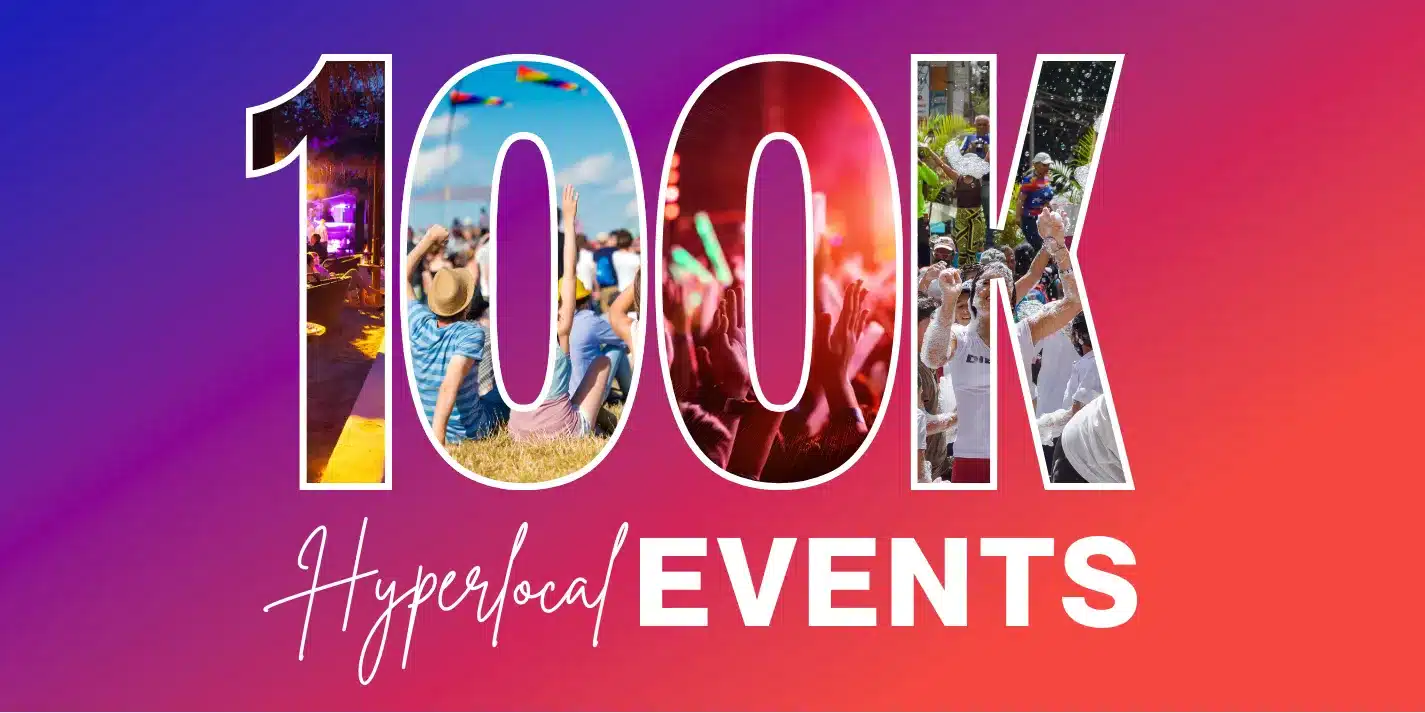
This week, Seeker Events Network crossed a major milestone: 100,000 hyperlocal events discovered, structured, deduplicated, and maintained by AI across our growing network of community publishers. But this isn’t a vanity metric. It’s proof of something we’ve been building toward for the past 2 years: A new model for community event discovery that actually works.
The Problem: Event Calendars Weren’t Built to Scale
Most community event calendars suffer from the same fatal flaw: they’re dependent on manual input.
Venues forget to submit events. Event organizers use different platforms. Information is scattered across dozens of niche sites. The result? Visitors see incomplete, outdated calendars. They stop checking. The calendar becomes a liability instead of an asset.
For DMOs, cities, and event organizers, this creates a no-win situation: Either spend hours every week manually curating events (time you don’t have), or let your calendar go stale (reputation you can’t afford to lose).
The Insight: Curation at Scale Requires a Network
Here’s what 100,000 hyperlocal events taught us: The solution isn’t better manual tools. It’s an AI-powered network.
When we started Seeker Events Network, one thing was clear: event calendars don’t scale when each organization works alone.
Seeker Events Network uses AI to discover hyperlocal events across a shared network of trusted sources. Communities curate locally, but discovery and learning happen across the network.
This milestone demonstrates that the model scales: every new event improves coverage, every approval improves accuracy, and the system gets smarter over time.
That’s what 100,000 hyperlocal events represents: a living, growing network of publishers, venues, and community organizations who have discovered that curation at scale is possible when you’re not doing it alone.
The Solution: How Smart Communities Are Scaling Event Discovery
So what does this look like in practice? Here are three patterns we’ve seen emerge from communities in our network:
The Collaborative Ecosystem
The most sophisticated communities use Seeker Events Network to create collaborative ecosystems where multiple stakeholders contribute to a shared calendar. DMOs, cities, universities, and business districts all feed into a central hub while maintaining their own branded calendars. This creates network effects: the more organizations that participate, the more comprehensive and valuable the calendar becomes for everyone.
The Automated Hub
Some communities use Seeker Events Network to fully automate their event discovery. They connect trusted sources—local venues, arts organizations, university calendars—and let AI handle the discovery and initial filtering. Events flow into a dashboard where humans make final approval decisions. The result: comprehensive, always-current calendars with minimal manual effort.
The Curated Network
Other communities take a more selective approach. They build networks of 20-30 highly trusted sources and use Seeker Events Network to keep those sources in sync. This creates a “best of” calendar that prioritizes quality over quantity—perfect for destinations that want to position themselves as curators of exceptional experiences.
What 100,000 Hyperlocal Events Actually Means
Here’s the thing about milestones: they’re only meaningful if they represent real value.
100,000 hyperlocal events isn’t just a big number. It represents:
- Millions of visitor experiences that were easier to discover and attend
- Thousands of hours saved by event organizers and communities who no longer manually curate calendars
- Hundreds of communities that have transformed their event discovery from a burden into a competitive advantage
- A network effect in action—the more events we discover, the better our AI gets at finding and categorizing new ones
Most importantly, 100,000 hyperlocal events represents an infrastructure built for scale. Community event discovery doesn’t have to be a manual, unsustainable burden. With the right network and the right tools, it can be automated, scalable, and genuinely valuable for both organizers and visitors.
The Road to 1 Million Hyperlocal Events
So where do we go from here?
While others are still debating whether AI has a place in community building, we’ve already demonstrated it. Seeker Events Network isn’t just participating in the future of hyperlocal event discovery- we’re actively building it. We’ve done the work to prove what’s possible. Now the question isn’t whether this AI-powered approach works, it’s how quickly communities will adopt it.
If you’re still managing your community’s event calendar manually, you’re working harder than you need to. The tools in Seeker Events Network exist to automate discovery, streamline curation, and create hyperlocal event hubs that visitors actually use.
The communities that thrive in the next decade won’t be the ones with the biggest marketing budgets. They’ll be the ones that make it effortless for locals and visitors to discover and experience everything their community has to offer.
100,000 events is just the beginning. The question is: will your community join us on the road to 1 million?
Ready to transform your community’s event discovery?
Book a demo to see how Seeker Events Network can automate your event curation and turn your calendar into a trusted destination.