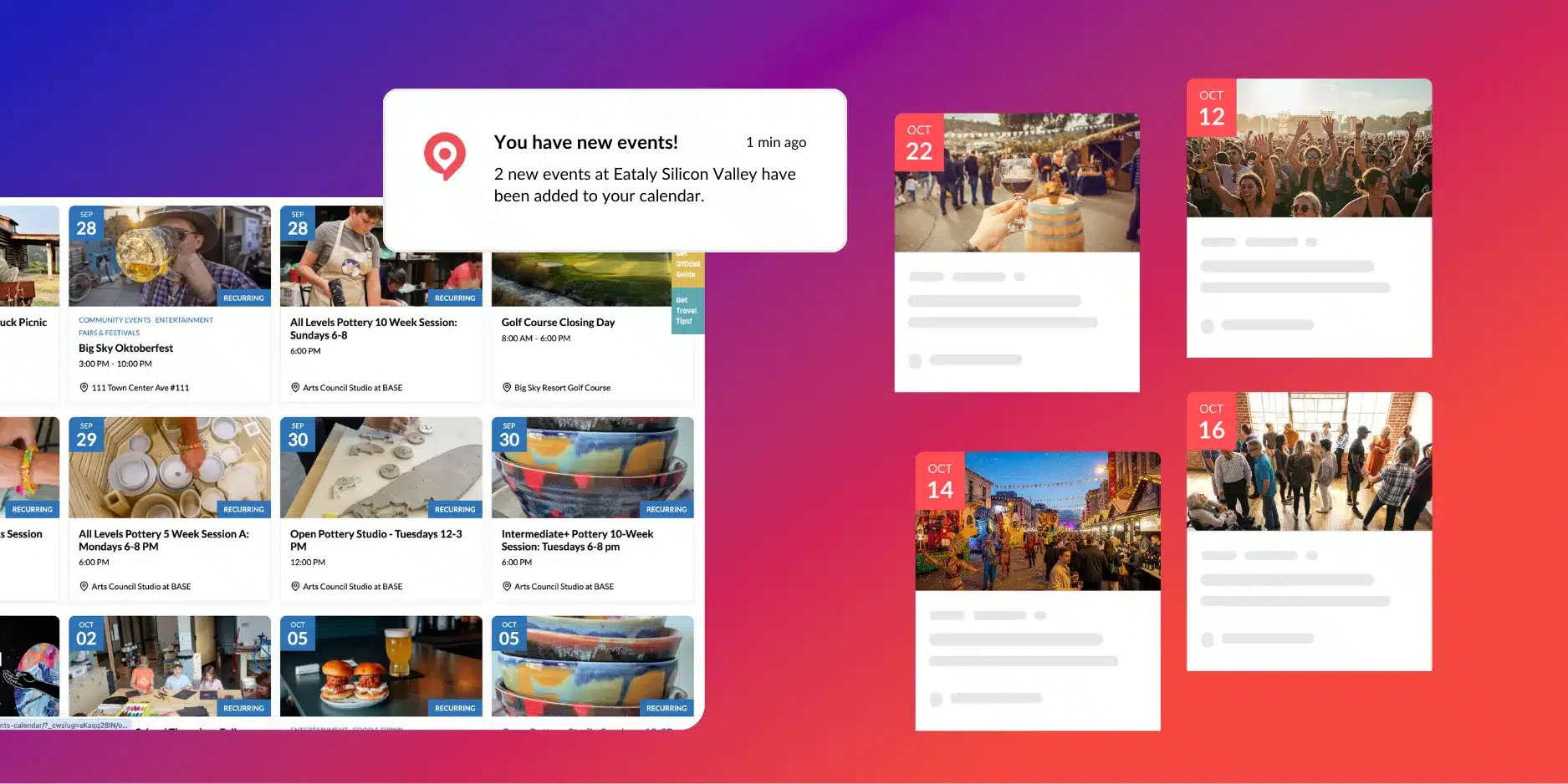
Most event calendars don’t fail because nobody cares. They fail because the work to fill them is brutal: scraping six platforms, chasing venues for submissions, hand-copying listings, and watching half the dates go stale by Friday. SF Peninsula solved that by routing 500+ connected sources into one calendar that updates itself. That’s the bar.
Seeker Events Network was built so a DMO, chamber, association, or publisher can clear that bar without a full-time data wrangler. Here are 7 things about how it actually works.
1. We can crawl any website
Event pages, venue calendars, city sites, arts orgs, universities, chambers, ticketing platforms. If it’s public, our AI can discover and ingest it. No RSS feed required. No manual data entry. No begging venues to submit their own events.
The result: your calendar fills itself while you focus on strategy, not scraping.
2. You can submit your own sources
Already trust a community blog, a niche venue calendar, or a university events page? Add them to your network and Seeker keeps them in sync automatically. You curate what counts as a trusted source. We handle the logistics of pulling, cleaning, and updating it.
3. Every source is human-curated for accuracy
AI handles discovery and scale. Humans review every new source for relevance, quality, and trustworthiness before it goes live in your calendar. That’s how your reputation stays intact: no spam, no scams, no stale listings.
4. You decide what goes live
Every event lands in your dashboard first. You control approvals, categories, visibility, and where each event publishes. It’s your calendar, your editorial standards, full control without the manual overhead.
5. We deduplicate and enrich the content
Five publishers list the same farmers’ market on five sites. Seeker merges those into one clean record, standardizes formats, and enriches the listing with venue details, images, and descriptions. Messy multi-source data becomes one professional, trustworthy entry your community can actually use.
6. Your events can live anywhere, not just your website
Every event in your network can sit on an embedded calendar, a standalone hub, or syndicate via API. One source of truth, distributed wherever your audience already is: partner sites, kiosks, mobile apps, third-party tourism platforms.
7. You can run it as a co-op across multiple organizations
This is the one most people don’t see coming. A single market doesn’t have to be served by a single account. Calgary is a working example: four accounts across four organizations, Tourism Calgary, Calgary Arts Development, Downtown Calgary, and Red Point Media, all contributing into a shared layer of events data for the same city. Four orgs, one Calgary, sharing the work and the coverage.
For destinations, chambers, and arts councils that have historically had overlapping but separate calendars, the co-op model means none of you has to be the lone owner. Each org keeps its own editorial control while the city gets one accurate picture.
How does Seeker Events Network compare to a calendar plugin?
A WordPress calendar plugin gives you a place to type events in. Seeker Events Network gives you the events. That’s the difference between a form and a feed. A plugin scales with how much typing your team can do. A network scales with how many publishers and sources you connect.
The network also gets smarter as it grows: every new publisher strengthens the dataset, which compounds across the whole network. More sources, better coverage, faster discovery.
The Bottom Line
If your events calendar requires a full-time employee to maintain, the calendar is the problem, not the employee. Seeker Events Network was built to fix that, whether you’re a single DMO (like SF Peninsula, with 500+ connected sources across 16 cities) or a four-org co-op (like Calgary).
Running a destination, chamber, or arts council calendar this quarter? Book a 15-minute walkthrough and we’ll show you what your calendar looks like the first week it’s live.